Full Moon by Yas Is is not simply a screenplay about travelling towards a destination. It is a poetic road film about memory, exile, Iranian identity and the unfinished parts of the self that no journey can leave behind.
Written by Yas Is, the pen name of Yasaman Esmailzadegan, Full Moon follows a woman travelling across roads, islands, shorelines and memories. Yet the screenplay's most significant journey occurs within her consciousness. Its landscapes are not passive settings. The straight road, the Persian Gulf, the snowy windscreen, the cemetery, the car mirror and the moon all become reflections of her unsettled inner life.
There are journeys undertaken in order to arrive, and there are journeys whose purpose is to postpone arrival. Full Moon belongs to the second kind. It quietly dismantles the traditional promise of the road film: movement does not necessarily bring freedom, distance does not guarantee escape, and crossing a border does not mean that anything has truly been left behind.
"Halfness" as the Central Metaphor of Full Moon
At the centre of Full Moon is the recurring idea of "halfness".
The woman's half-finished nail polish, incomplete smile, partially framed body and long list of abandoned ambitions could easily have become an overworked literary device. Yas Is, however, turns incompletion into something more substantial. It is not merely her protagonist's condition; it is the organising principle of the entire screenplay.
The woman describes herself as having been born half-finished. However, she does not present this condition simply as a weakness. Her halfness is also her identity, resistance and private language. It shapes the way she understands love, creativity, displacement and the many lives she might have lived.
The structure of Full Moon mirrors this state. The screenplay is episodic, fragmented and deliberately resistant to conventional dramatic completion. It repeatedly returns to roads, borders, mirrors, the sea and the moon. Its form behaves like its central character: always moving, yet never entirely arriving.
This is one of the screenplay's greatest achievements.
A Female Character Who Refuses to Be Simplified
The woman at the centre of Full Moon does not submit to the familiar demand that female characters must be coherent, likeable or easily understood.
She is tender, severe, wounded, intellectually restless, humorous and occasionally cruel. Her mind moves between classical music and everyday vulgarity, philosophical speculation and casual conversations, private grief and collective political memory.
She speaks of Haydn, Brahms, Baudrillard and Don DeLillo, but she also laughs at baby camels, struggles with a disconnected internet connection and listens to the conversations of friends. These shifts prevent her from becoming a purely symbolic or philosophical figure. She remains embodied in ordinary life, even when her thoughts move towards abstraction.
In an age when female characters are frequently praised merely for being "relatable", Yas Is offers something more valuable: a woman who does not make herself pleasant enough to be easily interpreted.
The Meaning of the Full Moon
The full moon initially appears to represent completion. The characters travel towards it as though seeing one complete thing might justify everything that remains incomplete within them.
But the moon does not heal the woman.
Instead, its completeness becomes almost hostile. It hangs above a life made from abandoned arts, interrupted relationships, forgotten languages and unrealised possibilities. Rather than repairing these fragments, the moon illuminates them.
This contrast gives Full Moon much of its emotional force. The woman is surrounded by the possibility of wholeness but is never forced into a false transformation. The screenplay refuses the conventional idea that a journey must end in healing, self-discovery or emotional resolution.
The woman does not need to become complete in order to become visible.
The Visual Language of Yas Is's Screenplay
One of the most convincing qualities of Full Moon is its visual imagination.
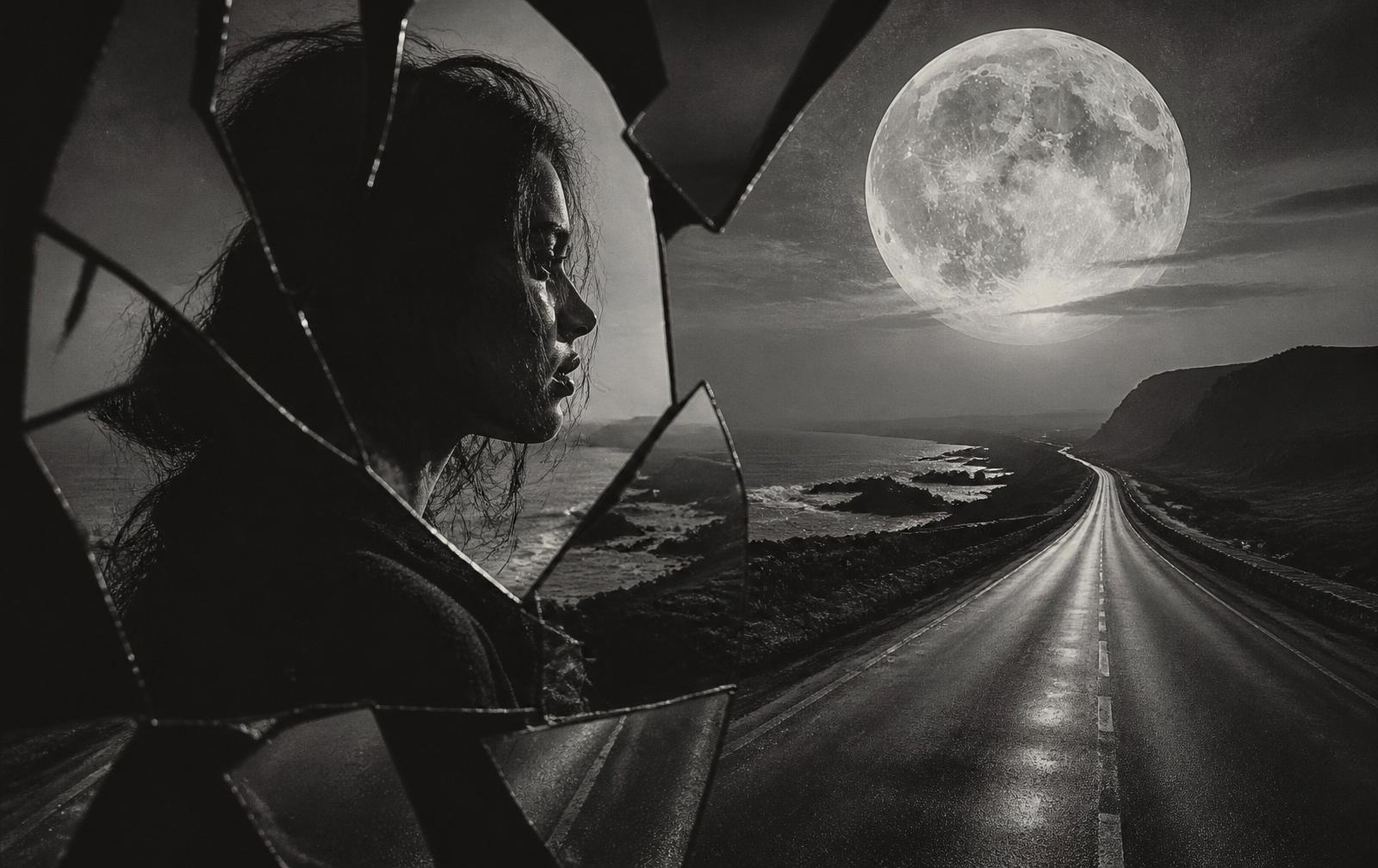
Yas Is creates a series of cinematic images that remain in the reader's mind: snow striking a car windscreen, a woman's feet standing on coastal rocks, sunset caught in dishevelled hair, a flower growing beside a grave, a face divided by light and the word "Iran" written in sand beside the sea.
These images give physical form to the screenplay's philosophical questions. The film does not merely tell us that the woman is divided; it repeatedly frames her in fragments. It does not simply describe uncertainty; it places her on a straight road that may lead nowhere.
The strongest images in Full Moon do not explain themselves immediately. They remain within the narrative, return in altered forms and gradually gather emotional meaning.
Exile, Iran and the Burden of Memory
As an Indian reader, I find the screenplay's treatment of displacement particularly recognisable.
In societies burdened by ancient histories, political upheaval, economic pressure, family expectations and inherited forms of belonging, leaving is rarely a purely personal act. A person does not depart alone. The homeland continues inside language, humour, shame, music, anger and memory.
Full Moon understands exile in this broader sense. Its characters move through roads and islands, but Iran continues to travel with them.
When the woman speaks of her sick land and the illness she carries from city to city, the metaphor becomes explicit. Yet it also reveals the screenplay's deepest political instinct: exile is not the removal of the self from a place. It is the continuation of that place within the self.
One of the screenplay's most effective political moments occurs during an informal rooftop conversation about Iran's disappearing middle class. The discussion moves between jokes, financial humiliation, childhood memories and political frustration.
The laughter does not diminish the seriousness of the subject. It makes it more human. Collective catastrophe is rarely experienced through uninterrupted solemnity. People survive it through anecdotes, vulgarity and humour sharp enough to keep despair at a manageable distance.
Where Full Moon Becomes Too Full
The intelligence of Full Moon is also the source of some of its weaknesses.
Yas Is does not always trust the strength of her own images. At several points, the voice-over explains what the road, mirror, moon or journey means after the visual language has already communicated it.
Literary, musical and philosophical references also accumulate rapidly. Jean Baudrillard, Don DeLillo, Truman Capote, Thomas Mann, Charles Baudelaire, Rumi and other cultural figures enter the protagonist's consciousness. Some of these references deepen the screenplay's intellectual world. Others feel deliberately displayed rather than emotionally discovered.
A literary reference should open a hidden chamber inside a work. It should not become a nameplate attached to a door that was already open.
The protagonist's cultural knowledge is clearly part of her personality, but a more selective use of references would give each one greater weight. Her own language is often powerful enough to stand without intellectual reinforcement.
Voice-Over, Repetition and the Need for Silence
The voice-over in Full Moon is intimate, literary and often striking. It allows the audience to enter a consciousness that is unable to move in a straight line, even when the road appears perfectly straight.
However, the narration sometimes overwhelms the image.
The woman thinks intensely and occasionally excessively. She names unfinished ambitions, philosophical ideas, private fears, old wounds and artistic influences. This mental excess belongs to the character, but it can also restrict the visual freedom of the screenplay.
The same issue appears in the use of repetition. Returning to the road, the moon and the question of where one stands can create poetic rhythm. Not every return, however, adds a new emotional layer.
The recurring question, "Where am I standing on the road?", is initially haunting because it connects physical location with existential uncertainty. Repeated too frequently, it begins to announce a meaning the road has already made visible.
A more rigorous edit could remove some of these explanations without damaging the screenplay's poetic character. Silence would allow its finest images to acquire greater authority.
Fragmentation or Accumulation?
The unconventional structure of Full Moon is thematically appropriate. A perfectly ordered version of this story might contradict its central idea of incompletion.
Nevertheless, thematic intention does not remove the need for rhythm.
Some observational sequences possess the raw intimacy of personal footage, but they do not all carry equal dramatic weight. There is an important difference between fragmentation and accumulation. Fragmentation allows the empty space between images to speak. Accumulation can fill that space before meaning has time to emerge.
A more selective structure would not necessarily make Full Moon conventional. It would make its unconventional qualities more precise.
The Male Character in Full Moon
The male character introduces another perspective on absence, abandonment and emotional distance. His narration contains moments of genuine vulnerability, particularly when he questions happiness, recognition and the painful silence between two people.
However, he remains less fully realised than the woman.
At times, he feels like an echo placed beside her consciousness rather than an equally distinctive consciousness of his own. This may be intentional, as Full Moon belongs unmistakably to its female protagonist. Still, a sharper contrast between their ways of seeing could have strengthened their relationship and made the emotional distance between them more painful.
A Screenplay Between Cinema and Confession
Despite its unevenness, Full Moon is far from an unsuccessful experiment. Its imperfections reveal an artist writing close to the dangerous boundary between cinema and confession.
The screenplay's excesses are the excesses of a mind afraid of omission. There is a feeling that if one quotation, memory, image or abandoned ambition is removed, an essential part of the protagonist might disappear with it.
That anxiety is not merely present in the writing. It is the source of the writing.
Yas Is's achievement lies in her refusal to transform incompletion into an inspirational lesson. The woman does not reach the moon and suddenly become whole. The road is eventually reversed, but reversal is not the same as return.
Even near the end, we are given only half a profile, half an image and half a face touched by light.
Final Verdict: Is Full Moon Worth Reading?
Full Moon by Yas Is is an uneven but intelligent, visually assured and deeply personal screenplay. It sometimes speaks when it should remain silent and explains what it has already shown. Its philosophical references occasionally crowd the emotional landscape, and some of its repetitions could be refined.
Yet it also offers a distinctive female voice, an evocative portrayal of Iranian displacement and a series of cinematic images that remain long after its intellectual declarations have faded.
The full moon does not complete the woman. It simply makes her fragments visible.
Perhaps Yas Is understands that visibility—not healing, arrival or perfection—is the most honest gift that art can offer.
- Author
- Krishna
- Role
- Literary Critic
- Reviewed Work
- Full Moon
- Writer
- Yas Is — Yasaman Esmailzadegan
- Publisher
- Senliz Publication
- Genre
- Literary Screenplay, Experimental Cinema, Poetic Road Film
- Publication Year
- 2026