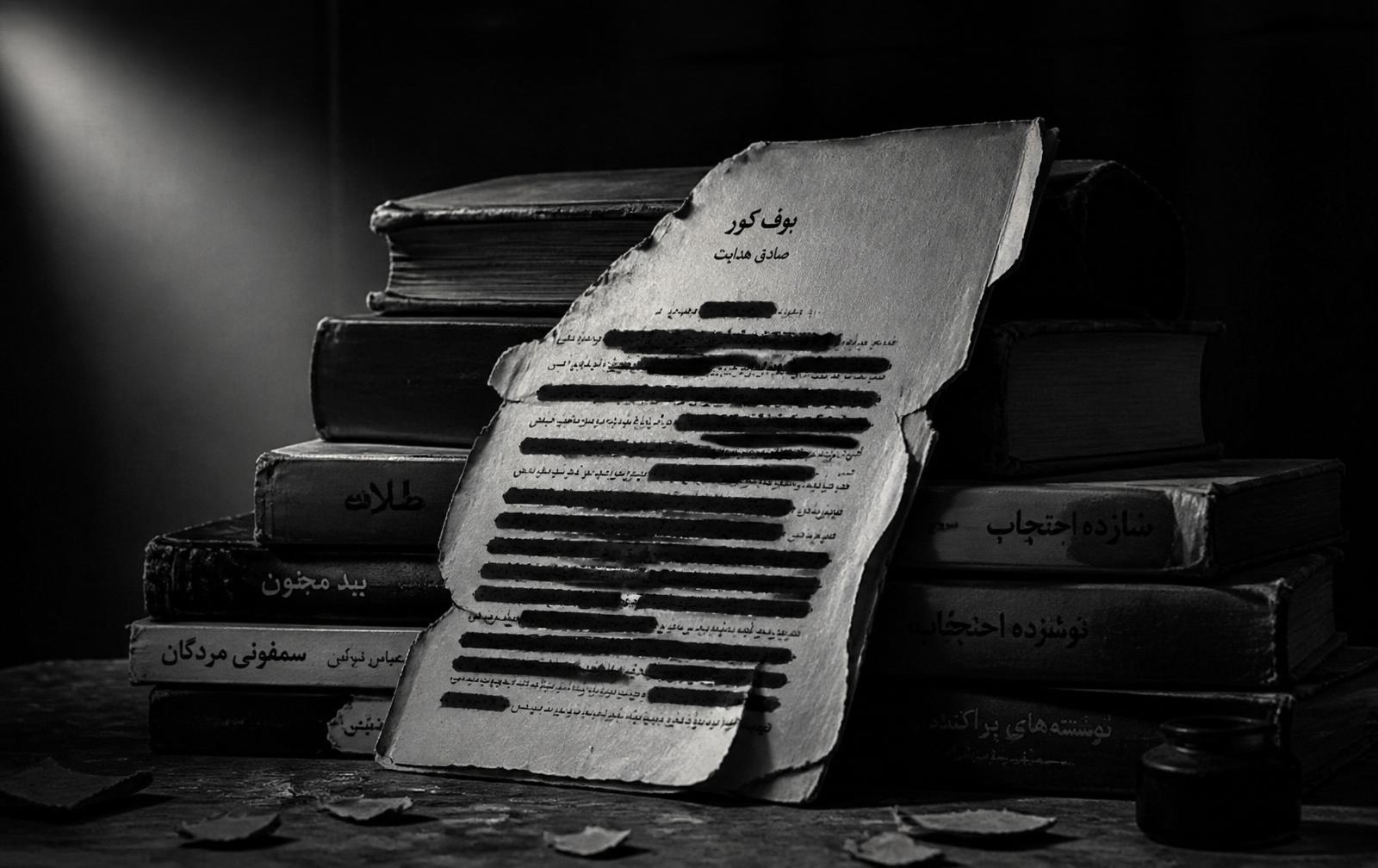
Censorship in Persian literature is not only a political issue. It is a psychological, cultural, and linguistic wound. After the 1979 Revolution in Iran, censorship became one of the most powerful forces shaping the destiny of Iranian writers, publishers, translators, poets, readers, and even ordinary citizens. It did not simply decide which books could be published and which books had to disappear. It gradually changed the relationship between the Iranian writer and language itself.
The most dangerous form of censorship is not always the visible one. It is not only the official rejection of a manuscript, the deletion of a paragraph, or the banning of a book. The deeper danger begins when censorship becomes internal. A writer may sit alone in a room, apparently free, with no censor standing beside them, and still find that their hand refuses to write certain words. The sentence is not banned yet, but it has already been weakened. The idea is not officially erased, but it has already been softened, disguised, or abandoned.
This is the hidden tragedy of censorship in Persian literature after the Iranian Revolution: it did not only control published books. It trained generations of writers to negotiate with fear before they negotiated with art.
“Censorship does not only remove words from books. It teaches the mind which words to fear.”
The Political Roots of Censorship After the 1979 Revolution
Before the 1979 Revolution, Persian literature had already experienced different forms of political censorship under monarchy, nationalism, security institutions, and ideological pressure. However, the post-revolutionary period created a new and more systematic relationship between literature and state power.
After the establishment of the Islamic Republic, literature was no longer treated merely as an artistic field. It became part of a broader ideological project. Books, newspapers, magazines, cinema, music, theatre, translation, and education were increasingly expected to align with the official moral and political identity of the new state.
The Ministry of Culture and Islamic Guidance became central to this system. For a book to be legally published inside Iran, it generally needed approval and publication permission. This meant that writers and publishers often had to submit manuscripts for review before publication. The process created a culture in which literature was not judged only by artistic quality, intellectual depth, or literary value, but also by whether it crossed political, religious, moral, or social red lines.
These red lines were often unclear. That ambiguity was part of the power of the system. When the boundaries are vague, writers begin to censor themselves more than the state asks them to. They do not know exactly what will be rejected, so they avoid more than necessary. Fear expands into imagination.
Censorship and the Control of Language
Language is never neutral. In literature, language is where memory, desire, rebellion, grief, and identity become visible. To censor literature is to control not only books, but also the emotional and symbolic vocabulary of a society.
In post-revolutionary Persian literature, certain subjects became dangerous or difficult: sexuality, the female body, religious doubt, political criticism, exile, imprisonment, alcohol, desire, loneliness, suicide, ideological violence, and alternative histories of Iran. Even when these subjects appeared, they often had to appear indirectly, symbolically, or through metaphor.
Persian literature has always been rich in metaphor. Classical Persian poetry often used symbolic language to speak about love, mysticism, power, and forbidden desire. But under censorship, metaphor changes its function. It is no longer only an aesthetic choice. It becomes a survival technique.
The writer learns to hide meaning inside images. The body becomes a shadow. Desire becomes a window. Political violence becomes weather. Prison becomes a room without a name. The beloved becomes an absent figure. The censor may cut a word, but the writer hides the wound inside rhythm, silence, and suggestion.
This produces a paradox. Censorship can sometimes make literature more symbolic, layered, and inventive. But this should not be romanticised. Creativity under pressure is still pressure. A flower growing through concrete does not justify the concrete.
Self-Censorship: When the Censor Moves Inside the Writer
The deepest effect of censorship is self-censorship. Self-censorship happens when the writer becomes their own censor before the official censor even appears. It is the moment when the mind says: do not write this, do not use this word, do not describe this body, do not question this belief, do not name this violence.
This is how censorship changes the mind.
A writer may technically be free in a private notebook, in exile, or on an uncensored platform, but the old mechanism remains inside them. They may still avoid certain words. They may still soften anger. They may still turn direct speech into metaphor. They may still feel guilt after writing honestly. They may still ask: Is this too much? Is this dangerous? Will this hurt someone? Will this be misunderstood? Will this be punished?
Over time, censorship creates a split inside the writer. One part wants to speak. Another part has been trained to survive. The result is a literature of hesitation, coded language, unfinished confession, and interrupted truth.
“The greatest losses of censorship are often the books that were never written.”
This psychological damage is difficult to measure because it often leaves no official record. A banned book can be listed. A deleted paragraph can be compared. But an unwritten sentence leaves no archive. The greatest losses of censorship are often the books that were never written, the poems that were never completed, and the words that never reached the page.
The Female Body and the Censorship of Desire
One of the most important areas of censorship in Persian literature after the Revolution has been the representation of the body, especially the female body. In many literary works, women could exist as mothers, martyrs, symbols, or moral figures more easily than as full human beings with desire, anger, sexuality, doubt, and contradiction.
This affected not only female writers, but the entire literary imagination. When the body becomes a forbidden subject, the language of intimacy is damaged. Love becomes abstract. Desire becomes guilty. The ordinary physical details of life disappear or become coded.
For women writers, censorship often created a double pressure. They had to write against political censorship and against patriarchal expectations at the same time. Their voices were judged not only as literature, but as moral acts. A woman writing about her own body, loneliness, anger, or sexual autonomy could be seen as threatening because she was not only telling a story; she was reclaiming authorship over herself.
This is why many works by Iranian women writers carry a powerful sense of confinement. Rooms, houses, gardens, mirrors, veils, windows, and locked spaces become recurring images. These are not just settings. They are symbolic structures of restricted existence.
Exile, Underground Publishing, and the Fragmentation of Persian Literature
Censorship after 1979 also changed the geography of Persian literature. Many Iranian writers left the country. Some continued writing in exile. Some published abroad. Some turned to underground circulation. Some remained inside Iran and developed complex methods of coded writing.
As a result, Persian literature became fragmented across different spaces: official literature inside Iran, censored but published literature, unpublished manuscripts, underground books, diaspora literature, digital publishing, and foreign-language translations.
This fragmentation created both loss and possibility.
The loss was clear: writers were separated from their natural readership. Books published abroad often struggled to reach readers inside Iran. Writers inside Iran had to compromise with censorship to be published legally. Readers became dependent on informal networks, PDF circulation, smuggled books, or edited versions.
But new possibilities also emerged. Exile literature created a new archive of Iranian memory. Diaspora writers were able to address subjects that were impossible or extremely difficult inside Iran. Digital platforms allowed some texts to escape traditional censorship. Translation introduced censored Iranian experiences to global readers.
Still, exile is not pure freedom. Many exiled writers carry the internal censor with them. They may live in free societies but continue to write with the memory of danger. Censorship follows the writer as an inner climate.
The Cultural Impact on Iranian Society
Censorship does not only affect writers. It affects readers and society as a whole.
When a society is repeatedly denied access to honest literature, it loses part of its ability to understand itself. Literature is one of the places where a nation processes trauma, desire, guilt, violence, love, failure, and historical memory. If literature is forced to lie, remain silent, or speak only in codes, society loses a mirror.
In Iran, censorship contributed to a culture of indirect speech. People learned to say things without saying them. They learned jokes, metaphors, hints, irony, and double meanings. This created a brilliant culture of coded expression, but also a culture of exhaustion. Constantly decoding language is mentally tiring. Constantly hiding meaning damages trust.
A censored society becomes suspicious of direct speech. People ask: What does this really mean? What is hidden behind this sentence? Who is listening? What can be said safely? What must remain private?
This affects family conversations, education, journalism, art, and politics. The result is a divided public language: one language for official life, another for private truth.
The Loss of Collective Memory
One of the most serious consequences of literary censorship is the destruction or distortion of collective memory. Literature preserves what official history often ignores: the emotional truth of ordinary people.
After the Revolution, many experiences became difficult to narrate openly: imprisonment, ideological violence, war trauma, religious doubt, women's private lives, the experience of minorities, political executions, exile, and the psychological cost of living under surveillance.
When these experiences are censored, a society does not simply forget them. Instead, memory becomes fragmented. It survives in whispers, family stories, banned books, underground archives, and private grief. The public record becomes incomplete, while the private record becomes heavy.
This creates a generational wound. Younger Iranians inherit silence without always knowing its origin. They feel the pressure of history but may not have access to the full language needed to understand it.
Censorship and the Transformation of Literary Style
Censorship has shaped not only what Iranian writers write about, but how they write. It has influenced form, structure, symbolism, narration, and even genre.
Many writers turned toward allegory, surrealism, fragmented narration, dream logic, historical displacement, and indirect political critique. A story set in a nameless city could be Tehran. A tyrant in a mythical land could be a modern ruler. A family conflict could represent national trauma. A love story could become a coded political text.
This indirectness has produced some remarkable literary strategies. But it has also created a burden. Writers are often forced to spend creative energy not only on beauty and truth, but on evasion. They must ask how to pass the censor, how to protect themselves, how to protect the publisher, and how to remain understandable to readers.
This changes the moral structure of writing. The writer is no longer only an artist. The writer becomes a strategist, a smuggler of meaning, and sometimes a witness speaking from behind a wall.
The Reader as Co-Conspirator
In censored literature, the reader also changes. Iranian readers have often become skilled interpreters of silence. They know how to read between lines. They notice what is missing. They understand that a simple sentence may carry hidden political meaning.
This creates a special relationship between writer and reader. The writer hides meaning; the reader uncovers it. Literature becomes an act of shared resistance.
“A society should not have to become expert in decoding its own literature in order to access truth.”
But again, this should not be romanticised. A society should not have to become expert in decoding its own literature in order to access truth. The beauty of hidden meaning does not erase the violence that made hiding necessary.
Banned Books, Delayed Books, and the Economy of Fear
Censorship also affects the publishing economy. When publishers do not know whether a book will receive permission, they take fewer risks. They may avoid controversial manuscripts. They may ask writers to edit themselves before submission. They may prefer safe topics, safe translations, safe authors, and safe language.
This creates an economy of fear.
The damage is not limited to banned books. Delay itself becomes a tool of control. A manuscript may wait months or years for permission. Writers lose momentum. Publishers lose money. Readers lose access. Some books become outdated before they are born.
In this system, censorship becomes not only ideological but also economic. It shapes what can be sold, translated, promoted, reviewed, and remembered.
The Internet, Digital Publishing, and New Forms of Control
The internet changed the landscape of censorship, but it did not end it. Iranian writers and readers gained new ways to circulate texts through websites, blogs, social media, PDFs, online magazines, encrypted messaging, and international publishing platforms.
Digital space allowed some literary voices to bypass traditional publishing barriers. It also created new forms of surveillance, filtering, intimidation, and legal risk. The censor did not disappear; it adapted.
Online censorship affects literature differently from print censorship. It is faster, more unstable, and often more invisible. A page can disappear. An account can be blocked. A writer can be threatened for a post rather than a book. The border between literature, journalism, activism, and personal expression becomes blurred.
This has expanded the meaning of the Iranian writer. Today, a poet, novelist, blogger, translator, feminist, bookseller, or literary podcaster may all become targets of censorship because all of them participate in shaping public imagination.
Why Censorship Changes Thought
The most important point is this: censorship does not only limit expression after thought has formed. It influences thought while it is forming.
Human beings think through language. If certain words become dangerous, certain thoughts become harder to reach. If certain subjects become shameful, the mind learns to walk around them. If certain truths are punished, imagination begins to develop safe routes.
This is why censorship can change the architecture of the mind.
A writer who avoids a forbidden word today may avoid an entire emotional territory tomorrow. A society that cannot publicly name violence may struggle to heal from it. A culture that cannot speak honestly about desire may confuse intimacy with guilt. A nation that cannot freely examine its past may remain trapped inside unresolved history.
The true goal of censorship is not only to silence speech. It is to reshape what people believe is speakable.
Persian Literature as Resistance
Despite decades of censorship, Persian literature has not been defeated. Iranian writers have continued to write, publish, translate, hide, resist, migrate, archive, and reinvent language. The history of Persian literature after 1979 is not only a history of suppression. It is also a history of survival.
Writers have used metaphor, irony, memory, exile, digital platforms, alternative publishing, and global translation to keep forbidden experiences alive. Readers have preserved banned books. Families have passed stories privately. Diaspora publishers have created new spaces. Women writers have expanded the language of selfhood. Younger generations have challenged inherited silence.
Persian literature remains powerful because it has carried truth even under pressure. But its endurance should not make censorship acceptable. Survival is not the same as freedom.
Conclusion: The Unwritten Archive
The story of censorship in Persian literature is ultimately the story of an unwritten archive. It includes the books that were banned, but also the books that were never started. It includes the poems that were deleted, but also the poems that the poet became afraid to imagine. It includes the words removed by officials, but also the words removed silently by the writer's own trained fear.
Censorship after the 1979 Revolution reshaped Persian literature by controlling publication, narrowing language, pressuring publishers, fragmenting literary communities, and forcing writers into self-censorship. But its deepest effect was cultural and psychological. It taught generations to negotiate with silence.
To defend Persian literature from censorship is not only to defend writers. It is to defend memory, language, imagination, and the right of a society to know itself honestly.